The SunWater Project – Advanced Solar Technology for Poor Farmers

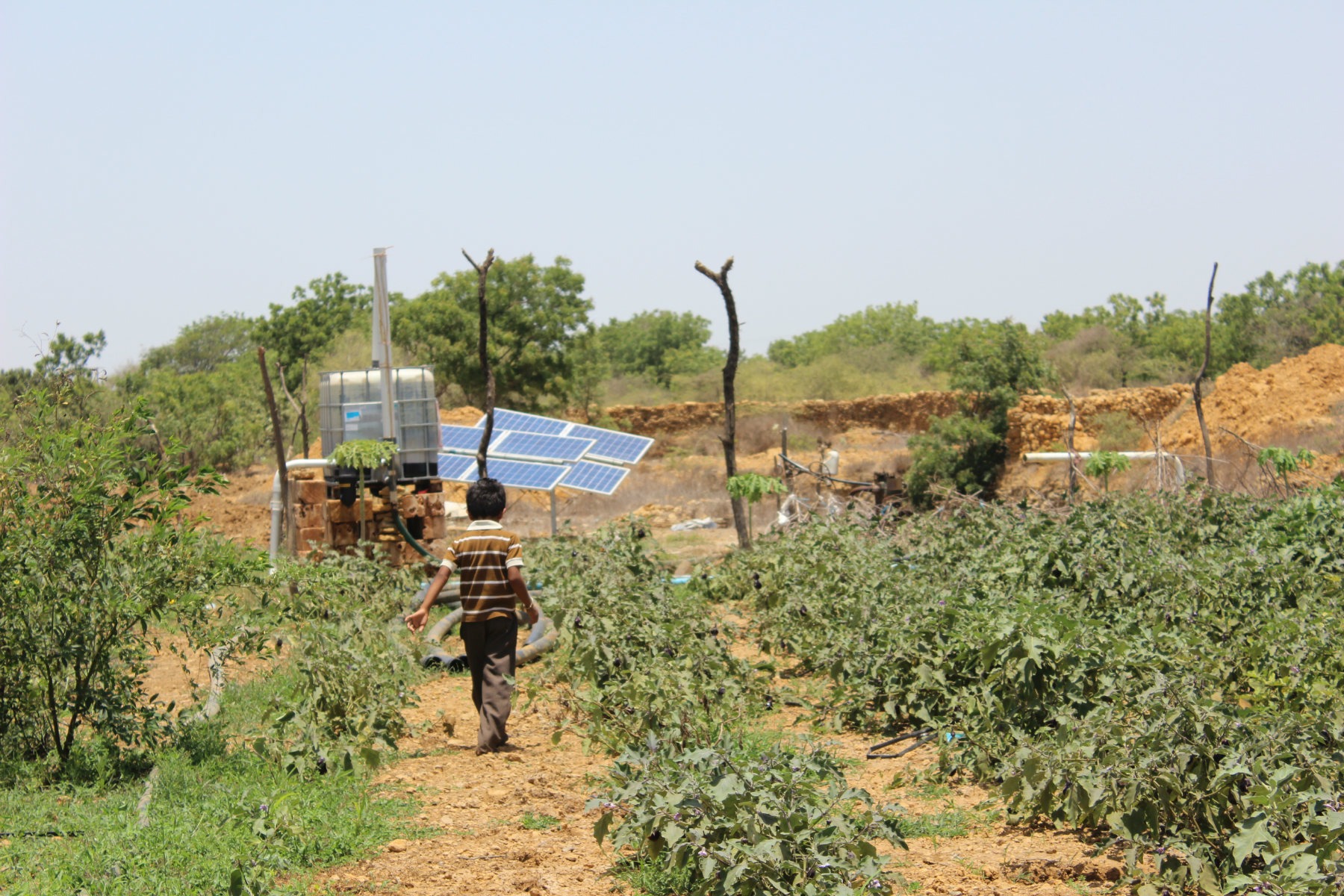
In my last article, you heard about SunWater, a project to build a radically affordable solar water pump for $2-a-day farmers that will transform small plot agriculture, create new water markets, and significantly increase incomes that will raise bottom-of-the-pyramid families out of poverty. Our target customers are small-plot farmers in India and Africa.


These farmers need a reliable, low-cost water pumping system so that they can grow cash crops to increase their incomes. They also need electric power to add value to their crops (grinding, processing, etc.) and for household use. Current pumping systems cost too much or are unreliable.

Solar pumping systems have been available for years, and they show great promise. But they haven’t been adopted at scale for a very simple reason. They cost too much!

The purchase price of solar PV systems is much too high to be competitive with diesel pumps, even though the fuel and repair costs of diesel pumps are astronomical.

If we could cut the cost of solar pumping systems by 80%, we could transform small farmer incomes, create tens of thousands of new jobs, and significantly lower carbon emissions.

How It Can Be Done

So, how can we radically reduce the purchase price of solar PV powered pumping systems along with technologies that efficiently transport irrigation water from the source to the plant? Here’s a deep dive into the different parts of SunWater!

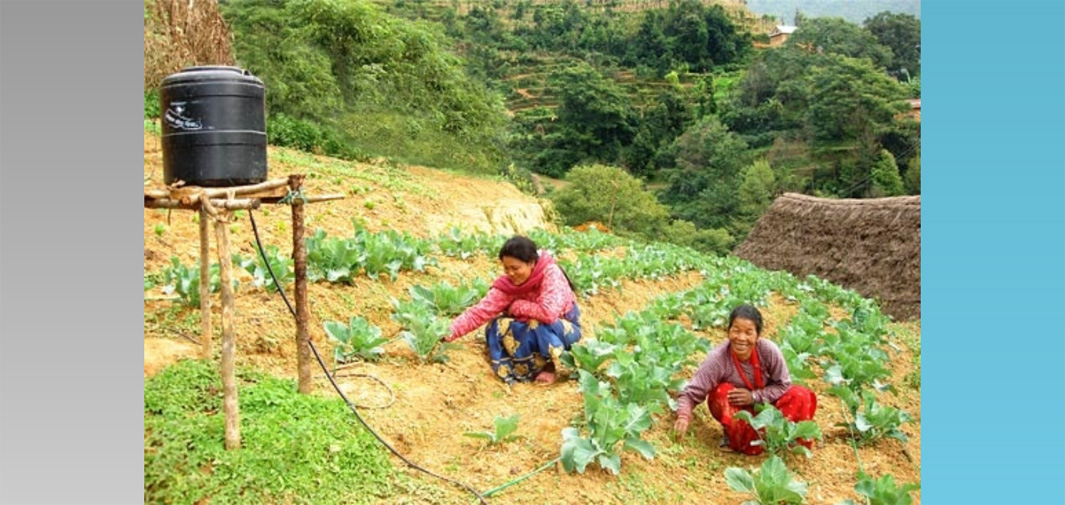
The good news is that affordable small farm systems are already available through the work of IDE. Through the work of IDE, the market price of drip irrigation has been drastically reduced by using comparatively thin walled lay-flat hose to convey irrigation water from sources like tube-wells to rows of plants. The cost of drip irrigation systems were reduced by designing affordable filters to remove dirt from the water, reducing system pressure to reduce the wall thickness of supply and lateral tubing bringing water to each plant, and simplifying the design of the emitters, or drip points, along each lateral. This reduced the cost of drip irrigation systems from about $1,200, or more to less than $600 per acre.

So what about the greater challenge of cutting the cost of a solar PV system and a pump motor combination from $7,000 to $2,500?

Here’s how I think it can be done:

1      Zero Based Design

In my new book with Mal Warwick, The Business Solution to Poverty: Designing Products and Services for 3 Billion New Customers we provide a detailed description of zero based design. Like zero based budgeting, it starts from scratch, making no assumptions about the technology and strategy that can best be used or created to address a specific problem. In this case, we’ve defined the problem as cutting the cost of an installed 2-kilowatt solar PV powered pumping system to $2,500. We have broken this down further to set a price target for the installed solar PV system of 70 cents a watt ($1,400 for a 2-kilowatt system), and the price of controller, pump and motor at less than $1,100, for a total retail price of $2,500. If we can achieve these targets, we believe solar PV powered pumping systems would be economically competitive with diesel-powered pumps, which would create transformative new energy markets in developing countries.

2       A Systems Approach to Design

To pull it off, we’ll need to work on solar pumping, irrigation, and livelihood enhancing high-value crop production and marketing as a total system, with each system component influencing the design of each other component, and of the total system. Figure 1 is a diagram of what this system looks like. Integrated financing also needs to be part of the system solution.

3      Mirrors are Cheaper Than Solar Panels

In spite of the fact that the price of photovoltaic (PV) solar systems have dropped significantly over the past ten years, the capital cost of an installed PV system used to pump irrigation water is still far too expensive to be competitive with diesel powered pump sets. But there are many options for further lowering the capital cost.

For example, a simple glass mirror is much cheaper than a solar panel. If we reflect the sunlight hitting ten glass mirrors that are a little bit bigger than the surface area of a 250 or 300 watt solar panel, we should be able to generate 2,000 watts from it. Since we’re pumping water, we can pump a small amount of water through a simple heat exchanger on the back of the PV panel to keep it from overheating. The mirror system would need to be incorporated into a simple frame that could be rotated to track the sun. This is just one out of the out-of-the-box solution that could lower the cost.  A simple initial prototype we built in collaboration with Ball Aerospace engineers worked pretty well. See Figure 2.

4      Improving Water Conveyance and Application Efficiency

Most diesel powered pumps convey water from the pump to the crop in unlined channels, and deliver it to plants by flooding the field, with the end result that 60 to 70 percent of the water pumped out of the ground is lost to seepage before it ever gets to the plants that need it. Using thin-walled lay-flat tubing to carry the water from the pump to the field, and low-cost drip irrigation to deliver water to the plants would double the overall efficiency of traditional water conveyance and application methods. This would either double the water available for irrigation or cut the size of the pumping system in half, either of which have the same functional impact as cutting the cost of the solar powered pumping system in half.


Fifteen years ago, I and my colleagues at IDE started designing and field testing a low-cost drip system for small farms that is about one half the price of conventional drip systems. Such a low-cost drip system costs about $1,400 for 2.5-acres, including the lay flat hose to carry water from the pump to the field, and IDE field tests in a variety of countries have demonstrated that typical farmers can earn net income after expenses of 45 cents/square meter, or $4,500 from a 2.5-acre plot of diversified high-value cash crops like off-season vegetables by putting the low-cost drip system to work.

5      Improving Farmer Income

You can’t pay for a low-cost drip system and a solar PV powered pumping system, and make a profit by using the water these systems produce to grow low value crops like rice, wheat, corn, and pulses. To earn a reasonable livelihood, small farmers need to learn to irrigate in the dry season when vegetable prices are two or three times as high as they are during rainy season when everybody can grow vegetables. Savvy farmers plant four or five high-value crops, because it’s impossible to predict what the market price for any one crop will be. Also diversified cropping both lowers risk and increases probability that at least one of the crops will generate lucrative profit. So, it’s just as important to help farmers optimize income as it is to lower the cost of pumping and improve the efficiency of conveying and applying water from the source to the crop.

6      Creating a Scalable Profitable Business Model

The best way to reach scale is to release market forces, creating opportunities for every participant in the marketplace to earn a reasonable profit. This includes the manufacturers of both the solar PV powered pumping systems and the irrigation systems, the dealers who sell them, the technicians who install them, and the farmers who buy them to improve their livelihoods.

The first barrier to profitability is the capital cost of $3,900 for the total system. Even though it can earn attractive returns on investment, the upfront cost is too high for most small farmers. For this reason, an important player in the system needs to be a business that offers the solar PV powered pumping and irrigation system on a lease basis or on credit, with the lease/credit business also earning an attractive profit.

SunWater is a project run by my company, Paul Polak Enterprises. We are partnering with a group of volunteer engineers from Ball Aerospace, the company that built the instruments on the Hubble space telescope, to build the proof of concept prototype of the $2,500 solar PV powered pumping system. Jack Keller, a world authority on drip and sprinkle irrigation, and Bob Yoder, an irrigation engineer I worked with at IDE, are working on the design of the total system and its beta testing and pilot commercial rollout in Gujarat, India. There we will be working with an Indian subsidiary of Paul Polak Enterprises, and they will play the local leadership role.

From Gujarat, SunWater India will initiate a full scale rollout of the affordable solar PV powered pumping and irrigation system in India’s Eastern states, where the majority of India’s existing 19 million diesel pumps are located. My dream is that after we create a new market for solar PV powered pressurized irrigation in India and other countries in Asia, we will repeat the process with a global commercial initiative to provide affordable village electricity to a significant percentage of the billion or more people in the world who lack a connection to the electric grid.

How You Can Help

Each dream starts with a first step, and our first step is to raise $50,000 in an Indiegogo campaign to fund the completion of the proof of concept prototype by volunteer engineers at Ball Aerospace. Ball Aerospace is providing their workshop facilities and their technicians are donating their time and talents as a contribution to this initiative. We are asking for help from the public to cover the estimated $50,000 cost of materials needed to develop, build, and bench-test the transformative proof of concept prototype. If you like this idea, I would very much appreciate your help — you can contribute to the Indiegogo here.

igg.me/at/solar-pump


Comments

comments

Powered by Facebook Comments

Read More

Four Transformative Business Opportunities in Emerging Markets

University of California, Berkeley- Haas School of Business March 13, 2012

I’m going to describe a little bit about the four businesses and then we’ll have a little bit of time for question and answers. Here’s an example in the area of health. The four businesses I talked about are: health, education, water, and energy. One opportunity in health is that about a billion people need reading glasses. You don’t have to design a technology; you can actually have reading glasses of various strengths built in mainland China for about 50 cents or less. The real challenge is the global distribution system and a robust sales rack that is available in the village. If a farmer in Orissa can’t read what’s on the package of vegetable seeds she might have a lot of trouble deciding what seeds to buy. That kind of a business can reach 100 million people who can’t see straight now. I’ve talked about the affordable safe drinking water model that we’re developing – it has huge potential economic impact and profitability for the company. In solar energy I think it’s possible to cut the functional cost of photovoltaics by 40 percent by using a low cost solar concentrator that concentrates ten times as much sunlight on a smaller solar strip. We are going to run a test to see if we can do that. D-Rev did that successfully by turning a 2 ½ watt into about 20 watts, [and] we are going to see if we can do that to produce 1,500 watts, which would then make photovoltaics competitive for solar pumping with diesel pumps. There are maybe 15 million diesel pumps in India today. Here’s another major initiative that we’re working on…coal represents 40 percent of carbon emissions in the world, and recently there has been tremendous interest on the part of utilities in Europe in replacing coal with torrefied briquettes. They’re using timber byproducts like sawdust and bark. They’re building fairly expensive $10 million to $40 million plants in North America that really do an initial stage of pyrolysis. They heat sawdust to something like 300 degrees for three hours or so in the absence of oxygen that produces a blackened product, which can be coal fired with coal without any capital investment. If you burn plant biomass, it has taken carbon out of the air and then if you burn it efficiently, it puts it back with zero unbalanced carbon emissions impact, compared to taking coal which is sequestered under the ground and releasing it in the air. So this is a major initiative going on now, financed by utility companies in Europe. The thing is that you can do the same with any plant biomass. Six billion tons of coal is burned every year, and there’s four billion tons of agricultural waste produced every year. The real challenge is that waste is dispersed in decentralized locations in villages. When it’s bulky and relatively cheap, the transport costs kill you. So when the process of designing not a $10 million torrefaction plant but a $10,000 village-based torrefaction plant with a three kilometer collection radius, it’s the reverse of last-mile distribution – it’s last mile collection. If that’s successful it could be a $10 billion dollar company. We’re doing a beta test in India over the next six months to make that work. Right now, there’s 1.25 billion tons of charcoal. That’s a $15 billion market today – just charcoal. Just to wrap up, there are 2.6 billion customers waiting for a revolution in global business. I ask how many of you can help lead that revolution?

Comments

comments

Powered by Facebook Comments

Read More

Four New Global Businesses

Haas School of Business, University of California Berkeley- March 13, 2012

My dream is to create four new global businesses. Each one of these businesses will serve at least 100 million customers, generate at least ten billion dollars in sales, and show attractive profits. To create businesses like this is a much higher risk because of the unknown nature of the market. But it carries with it a much higher return if successful. So, I am totally at the opposite end of the people who feel that investors in this market should expect low returns, or no return, or to be charitable. Or, like Muhammed Yunus, who says that he expects investors in social businesses to just get their money back when the business is successful. That to me amounts to about a 50 percent subsidy. I think that investors in this space should expect a very attractive return, commensurate with the risk, but be willing to accept the very high degree of risk because of the uncertainty of creating a totally new transformative product. I want to create these global businesses in water, energy, health, and education. I’ve started the business in water, [it] is in the late beta-test stage; [in] the business in energy there are two initiatives in an earlier stage; and health and education are on the backburner until we get the first two up and running. We’re also negotiating with several multinationals because there is a tremendous amount of interest in this space. So as I said before, the dream is that each of these new businesses creates ten billion dollars in sales and reaches at least 100 million two-dollar-a-day customers. These are the most unserved or bypassed customers in the world right now.

Comments

comments

Powered by Facebook Comments

Read More

The Next Digital Revolution

Paul Polak at the the Seoul Digital Forum 2012

Paul Polak speaking on the Next Digital Age

It’s a great pleasure to be here today.

I was stimulated and challenged by Steve Ballmer’s keynote address this morning, especially the description of the new Windows 8 and all its bells and whistles. But I had one problem with it. What Steve talked about has no relevance at all to the 2.6 billion customers in the world who live on less than two dollars a day. I believe it’s those customers, and their tastes and preferences that will determine the success or failure of companies like Microsoft within the next 25 years.

I am going to talk to you today about three things. The first of which is: business for the other 90 per cent. Secondly, the role that simplicity and appropriate technology can play in businesses for the other 90 percent. Thirdly, I’ll touch upon the future of the digital revolution.

Let me start by pointing out that Microsoft and most of the other businesses in the world are wholly focused on servicing and delivering products to the richest ten per cent of the population. We need a revolution in business to reach the other 90 per cent. The reason for that revolution is not because it’s morally right to serve poor people as customers but because there are massive new profitable markets awaiting any bold company that is willing to take the risk to design ruthlessly affordable products and services to reach that under served market of the other 90 per cent. In my view, the most important subsector of the other 90 per cent are the 2.6 billion customers, about 40 per cent of all the customers in the world, who live on less than two dollars a day.

Let me say a little bit about appropriate technology and simplicity. When I started working in development some 30 years ago, a book called “Small is Beautiful,” by Fritz Schumacher inspired me. Unfortunately, the appropriate technology movement that was created by Fritz and that book died 20 years ago. It died because it was peopled by tinkerers who solved technical problems with technology instead of hardheaded entrepreneurs who design for the market.
The irony is that the giants of global business have used some of the basic principles of appropriate technology effectively. Those giants and the companies they formed literally transformed business as it is today.

Before I discuss that process, I want to say a little bit about what “the other 90 per cent” consists of. Let me point out that there are some 5.6 billion people in the world who earn less than $5,000 a year, which is about 14 or 15 dollars a day. There are 2.6 billion people in the world who earn less than two dollars a day. Eighty per cent of all of the people in the world earn less than ten dollars a day. That is a massive market opportunity that conventional big businesses are missing out on. Some cutting-edge businesses are indeed paying a lot of attention. Cummins Inc., as an example, earns the majority of its profit and growth in countries like China and India. But that company took the risk to get involved there 25 years ago. More than 40 per cent of Unilever’s sales come from emerging markets. Procter & Gamble, which has 20 brands that sell a billion dollars a year, is trying hard to catch up with Unilever in terms of getting more customers at the bottom of the Pyramid.


In the digital field, mobile phones are already providing a variety of vital financial services to customers who live on less than two dollars a day. They are also providing vital information for dollar-a-day, one-acre farmers concerning the best locations for them to sell their crops. Overall, there is a huge unmet opportunity.

Masai Goat Herder Making Use of A Cell Phone

Let me go back to simplicity and appropriate technology. Although I believe the appropriate technology movement died, all of the things that I consider to be major breakthroughs in business have at least two things in common. They are: radical innovations in affordability, as well as in miniaturization. For example, in 1927, the U.S. auto industry was selling primarily to rich playboys. AtPictured Left- 1927 Cadillac LaSalle, $2685, 3770 pounds Pictured Right- 1927 Ford Model T, $360, 1655 poundsthat time there were two dominant models: The Cadillac La Salle cost about $2,700 and weighed 3,770 pounds, while the Ford Model-T, introduced by Henry Ford, cost $360 and weighed less than half of the La Salle.

Pictured Left-1927 Cadillac LaSalle, $2685, 3770 lbs. Pictured Right 1927 Ford Model T, $360, 1655 lbs.

Of course, Ford’s dream was to create a car that was attractive to the working class. But what happened next? This is a trend that I’ve seen in many transformative businesses — they inevitably go up-market. The successors of Ford’s inventions in Detroit became: Chrysler, Ford and General Motors, formerly known as the “big three”. General Motors was the biggest car company in the world some years ago. The large aspirational model with high margins that General Motors, Ford, and the others made big profits on. But three years ago, Ford, Chrysler and GM were all almost brought to their knees by a number of factors, including competition from Japanese and German cars. These overseas competitors were smaller, cheaper and more fuel-efficient. As time goes on, Japanese car makers are finding that Korean cars are the new competition, primarily on price point. This is a visible trend.

 When computers filled a whole room in a college and cost $50,000 to a million dollars, Steve Jobs and Steve Wozniak created the Apple II computer, which sold for about $1,300, weighed 34 pounds and was small enough to sit on a desk.

Pictured Left – Mainframe computer circa 1977 Pictured Right – Apple II Computer circa 1977


Again, it’s all about miniaturization and affordability. So, what happened to the personal computer that Apple developed? Well, IBM entered the market and through mass manufacturing and other things, created a product that was not as cool, not as user friendly, but was more affordable and readily available in large quantities. This is how IBM and an army of PC clones took over that market.

So, what’s needed to reach the other 90%? First, a company has to pursue what I call the ruthless pursuit of affordability. Second, the company needs to understand in depth, the customers in “the other 90%”. Third, it’s critical that the company know everything there is to know about the context.

It’s quite a challenge to learn about the preferences of the other 90%.   Another great challenge is the problem of last mile distribution. A final challenge is how to reach scale. I think these markets can be very successful and very profitable. What I am doing now is creating new companies that are capable of each reaching 100 million customers and generating $10 billion in sales.

So how does all of this apply to the digital revolution? Well let’s look at some of the companies that are current leaders. Apple is the richest company in the world. It basically makes cool toys for the ultra rich, probably the top five per cent of the world’s customers. Microsoft’s product line is also focused on the richest 10 per cent. Although they now have to deal with the challenge of Chinese knock-offs of Windows sold through EBay. As I’ve said before, mobile phones are already in the market of reaching poor people. There is One Laptop Per Child, a charity model that provides computers to middle-class children even though there are nearly a billion people in the world who don’t know how to read and write. Then, there is the $500 iPad. Apple is making very good profits on iPads and iPhones.


Recently a company called Datawind introduced a tablet device in India, referred to as the $35 tablet, but selling for around $50. That company had problems, but it demonstrates that it is possible to create a tablet for $35.

Pictured Left- $500 iPad – Pictured Right-$35 Aakash tablet

In my view, if companies in the digital space can develop a $35 computer device, my challenge to Apple and other companies in this space to create a $15 iPad.

They could establish a base at the Bottom of the Pyramid, which will give them immense strength to serve affluent customers at the same time. Will the digital revolution learn to operate successful businesses at scale, which are profitable for the other 90%, or, will the digital companies face the same competitive challenges that General Motors faced?

I hope that products like a $35 computer and a $15 iPad are produced in the next five years. What will the actual performance of the digital industry of the future be? Only time will tell.

Comments

comments

Powered by Facebook Comments

Read More